
PKRVIP Underage Gaming Policy

Online gaming platforms have a responsibility to ensure that their services are not accessible to children or other individuals who do not meet the required age criteria. For platforms such as PKRVIP, an effective Underage Gaming Policy should combine age restrictions, identity verification, account monitoring, parental awareness, and responsible-gaming practices.
For users in Pakistan, this issue is particularly important because gambling and gaming activities can be subject to significant legal restrictions. Pakistan’s gambling framework includes the Public Gambling Act and the Prevention of Gambling Act, while the exact treatment of online activities can depend on the applicable provincial and federal rules.
What Is the PKRVIP Underage Gaming Policy?
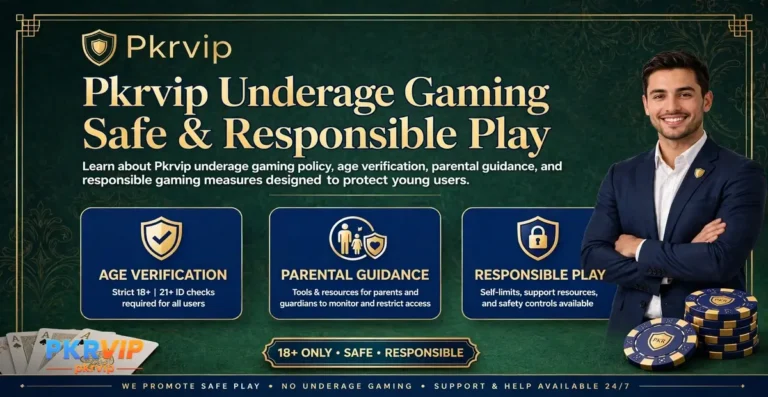
The PKRVIP Underage Gaming Policy is designed to prevent minors from accessing real-money gaming services. The central principle should be simple: only users who satisfy the platform’s applicable minimum-age requirement may create an account, deposit money, or participate in real-money gaming.
PKR VIP Games’ published privacy policy states that its service does not address anyone under 13 and that it does not knowingly collect personal information from children under that age. It also states that parental consent may be required where applicable.
However, users should distinguish between a website’s privacy-policy age statement and the legal eligibility requirements that may apply to real-money gambling. Anyone considering such services in Pakistan should verify the current law and the platform’s current Terms and Conditions before participating.
Why Preventing Underage Gaming Matters
Protecting minors is more than a formal website requirement. Young people may not fully understand financial risk, probability, wagering, or the potential consequences of gambling-related behavior.
An effective underage policy helps:
- Prevent children from opening gaming accounts.
- Reduce unauthorized deposits and wagers.
- Protect minors from gambling-related financial risks.
- Prevent the misuse of another person’s identity documents.
- Encourage parents and guardians to monitor access to gaming services.
- Support responsible gaming among eligible adults.
Age restrictions also help gaming operators establish clearer standards for account registration and identity verification.
Age Verification and Identity Checks
One of the strongest safeguards against underage gaming is age verification.
A responsible platform can require users to provide accurate information during registration and, where necessary, verify their identity using appropriate documentation. Depending on the applicable requirements, verification may involve checking a user’s date of birth and government-issued identification.
For Pakistan-based users, identity documents such as a CNIC or passport may be relevant to KYC procedures when a platform requires identity verification. Other gaming platforms operating in the Pakistani market publicly describe CNIC or passport checks as part of their age-verification procedures.
Importantly, users should never attempt to bypass age verification by using another person’s identity, falsifying their date of birth, or providing inaccurate documentation.
What Happens If a Minor Accesses an Account?
A strong underage policy should provide a clear procedure when a minor is discovered using an account.
The account may be restricted or suspended while the operator investigates the circumstances. The platform can then review registration information and identity documents to determine whether the account holder satisfies the applicable age requirement.
If an account is confirmed to belong to an underage user, the appropriate response may include:
- Closing or restricting the account.
- Preventing further deposits or gaming activity.
- Reviewing the account and transaction history.
- Handling any remaining funds according to the platform’s Terms and Conditions and applicable law.
- Taking additional measures to prevent the account from being reopened improperly.
The exact treatment of deposits, winnings, and refunds should always be determined by the platform’s current terms and applicable Pakistani law rather than assumed in advance.
Parents and Guardians Have an Important Role
Technology alone cannot completely prevent underage access. Parents and guardians can provide an additional layer of protection.
Families can use:
- Device-level parental controls.
- Strong passwords and device PINs.
- Separate user profiles on shared devices.
- Browser restrictions where available.
- Regular supervision of children’s online activity.
- Open conversations about the risks associated with real-money gaming.
Parents should also avoid allowing children to use an adult’s gaming account. Sharing login credentials can make age controls less effective and can create security and financial problems for the legitimate account holder.
Responsible Gaming in Pakistan
Underage protection should form part of a broader responsible-gaming framework. Eligible adults should understand that gaming involving real money carries financial risk and should never be treated as a guaranteed method of earning income.
Responsible gaming generally means setting reasonable limits, avoiding chasing losses, and taking a break when gaming stops being recreational.
Players should also be aware of the legal environment in Pakistan. The Public Gambling Act contains provisions concerning common gaming houses and unlawful gaming, while the Prevention of Gambling Act 1977 provides another important part of Pakistan’s gambling-law framework.
Because online gambling regulation can be legally complex, a platform’s availability in Pakistan should not automatically be interpreted as government authorization or licensing.
Zero-Tolerance Approach to False Age Information
A credible underage policy should make clear that deliberately providing false age information is unacceptable.
Users should register only with their own accurate personal information. Attempting to appear older, submitting someone else’s identification, or allowing another person to use an account can undermine the platform’s age-verification controls.
Where a platform identifies suspicious or inconsistent information, it may reasonably require additional verification before allowing continued access.
Protecting Personal Information
Age verification must also be balanced with privacy and data protection.
When users submit identification documents, they should understand why the information is being requested and how it is handled. PKR VIP Games’ published privacy policy states that it takes steps to remove personal information when it becomes aware that it has collected information from someone under 13 without the required parental consent.
Users should therefore review the platform’s current Privacy Policy and Terms and Conditions before submitting personal documents.
Conclusion
The PKRVIP Underage Gaming Policy should be viewed as an essential protection for minors rather than simply a registration requirement. Effective age controls, identity verification, account monitoring, privacy safeguards, and parental involvement can work together to reduce the possibility of underage access.
For users in Pakistan, there is an additional consideration: gambling laws and the legal status of online gaming can be complicated, so users should not rely solely on a website’s own claims about legality. Pakistan’s existing gambling legislation includes provisions dating from earlier legal frameworks, and current applicability can depend on the particular activity and jurisdiction.
Ultimately, minors should not participate in real-money gambling, users should provide truthful information, and anyone considering an online gaming service in Pakistan should check both the platform’s current rules and the applicable local law before playing.